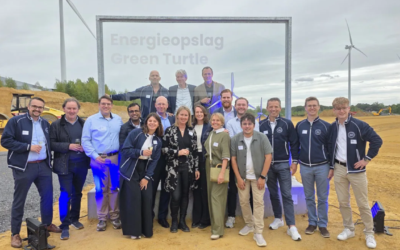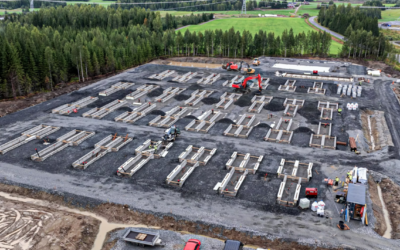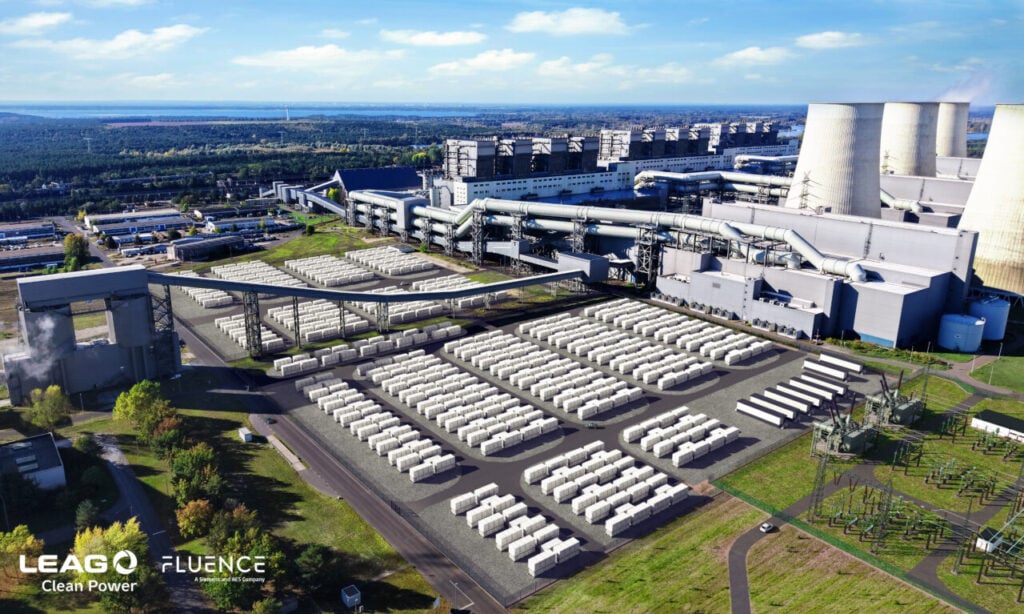
The low-carbon subsidiary of German energy company LEAG is constructing Europe’s largest single-site battery storage project, in partnership with Fluence.
LEAG Clean Power will deploy the 1GW/4GWh standalone battery energy storage system (BESS) in Jänschwalde, a municipality in Germany near the country’s eastern border with Poland.
Called GigaBattery Jänschwalde 1000, the project will be a key part of GigawattFactory, a portfolio of low-carbon power generation, battery storage and hydrogen assets that LEAG is constructing, owning and operating. It includes solar PV and wind, BESS, green hydrogen and hydrogen-ready thermal power plants.
Jänschwalde is in the Lusatia region of Europe, territorially split between Germany and Poland. The area has historically been closely tied to the coal industry, particularly lignite.
Try Premium for just $1
- Full premium access for the first month at only $1
- Converts to an annual rate after 30 days unless cancelled
- Cancel anytime during the trial period
Premium Benefits
- Expert industry analysis and interviews
- Digital access to PV Tech Power journal
- Exclusive event discounts
Or get the full Premium subscription right away
Or continue reading this article for free
LEAG still operates a 3,000MW lignite-fired power plant adjacent to the GigaBattery site and its cooling towers can be seen in renderings of the BESS project released by the project partners. The company also operated an opencast mine at Jänschwalde, as well as a nearby mine at Cottbus-Nord, which supplied the lignite plant until both mines were closed in 2023.
Cottbus-Nord mine has been turned into a lake and wildlife area, while Jänschwalde now hosts LEAG’s new GigawattFactory infrastructure.
LEAG Group CEO Adi Roesch said the project is “another growth accelerator” for the GigawattFactory strategy and portfolio.
“The key to the energy system of the future lies in the combination of renewable energies, demand-driven storage, and flexible power plants,” Roesch said.
“The technical design as a 4-hour storage system supports the further expansion of renewable energies at the GigawattFactory, helps stabilise the grid and, thanks to lower specific investment costs, enables optimal utilisation of the existing grid connection,” Thomas Brandenburg, LEAG Clean Energy managing director, said.
Fluence supplying SmartStack 7.5MWh AC BESS solution
Fluence will supply its SmartStack BESS solution to the project, equipped with lithium iron phosphate (LFP) chemistry battery cells.
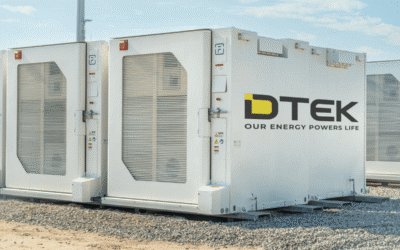
SmartStack is an AC block solution with an energy storage capacity of up to 7.5MWh per unit, designed with battery hardware on top and balance of plant (BOP) components underneath.
It’s shipped in two pieces and assembled onsite, which the company claims enables simple transportation logistics, despite the completed product being slightly longer and considerably taller than the standard 20-foot ISO container configuration adopted by most of the industry.
SmartStack launched earlier this year with its trade show debut at the Energy Storage Summit EU 2025 hosted by our publisher Solar Media in February.
Fluence began mass production of units from a new factory in Vietnam in Q3 this year. The assembly plant has 35GWh annual production capacity and will serve Fluence’s utility-scale BESS markets outside the US, making both SmartStack and its predecessor, GridStack Pro.
How GigaBattery Jänschwalde 1000 compares to Europe’s other biggest projects
Commenting on business networking site LinkedIn, Fluence policy & market development manager Lars Stephan said the GigaBattery Jänschwalde 1000 project’s targeted completion date in 2027-2028 is considerably sooner than the 28 years for development and six years for construction that it took to build Germany’s biggest pumped hydro energy storage (PHES) facility, Goldisthal.
At 1GW/8GWh output and capacity, the Goldisthal project is broadly comparable in scale to the new battery installation.
Stephan also noted that Germany’s installed capacity of large-scale BESS today is less than the capacity of the new project, at about 3.2GWh.
Just in the last few days, utility RWE has announced the start of construction at ‘Germany’s biggest project,’ a 400MW/700MWh system in Bavaria, southern Germany, and this morning, Energy-Storage.news reported that development platform Eco Stor has begun construction on a 300MW/700MWh project in Saxony-Anhalt.
The country’s biggest BESS project currently in operation is Eco Stor’s 103.5MW/238MWh asset that went into operation this summer in Bollingstadt, Schleswig-Holstein.
A few weeks ago, developer Fidra Energy reached financial close on a 1,400MW/3,100MWh project, Thorpe Marsh, in Yorkshire, northern England. The largest project inaugurated in Europe to date is thought to be Statera’s recently completed 300MW/600MWh Thurrock Storage project in the UK.
Within the European Union (EU), a 496MWh project in Lovech, Bulgaria, was recently claimed to be the largest online so far.
Certainly, the trend in Europe, as in the US, has been towards larger average project output and capacity. Notable examples include Netherlands-headquartered Giga Storage, which is developing a 700MW/2,800MWh project in Belgium and a 1,200MWh project in its home country. Giga Storage recently acquired a 350MW/1,400MWh development project in Germany.
In Poland, considered one of Europe’s fastest-growing country markets alongside Germany, the UK and Italy, utility PGE has started building a 981MWh project using batteries made locally by LG Energy Solution (LG ES).
In Italy’s recent 10GWh MACSE energy storage procurement tender, hosted by national grid operator TERNA, one winning project from Enel Green Energy is planned at 574MW/3636MWh (6.2-hour duration), due to go into operation in 2028.